Summary:
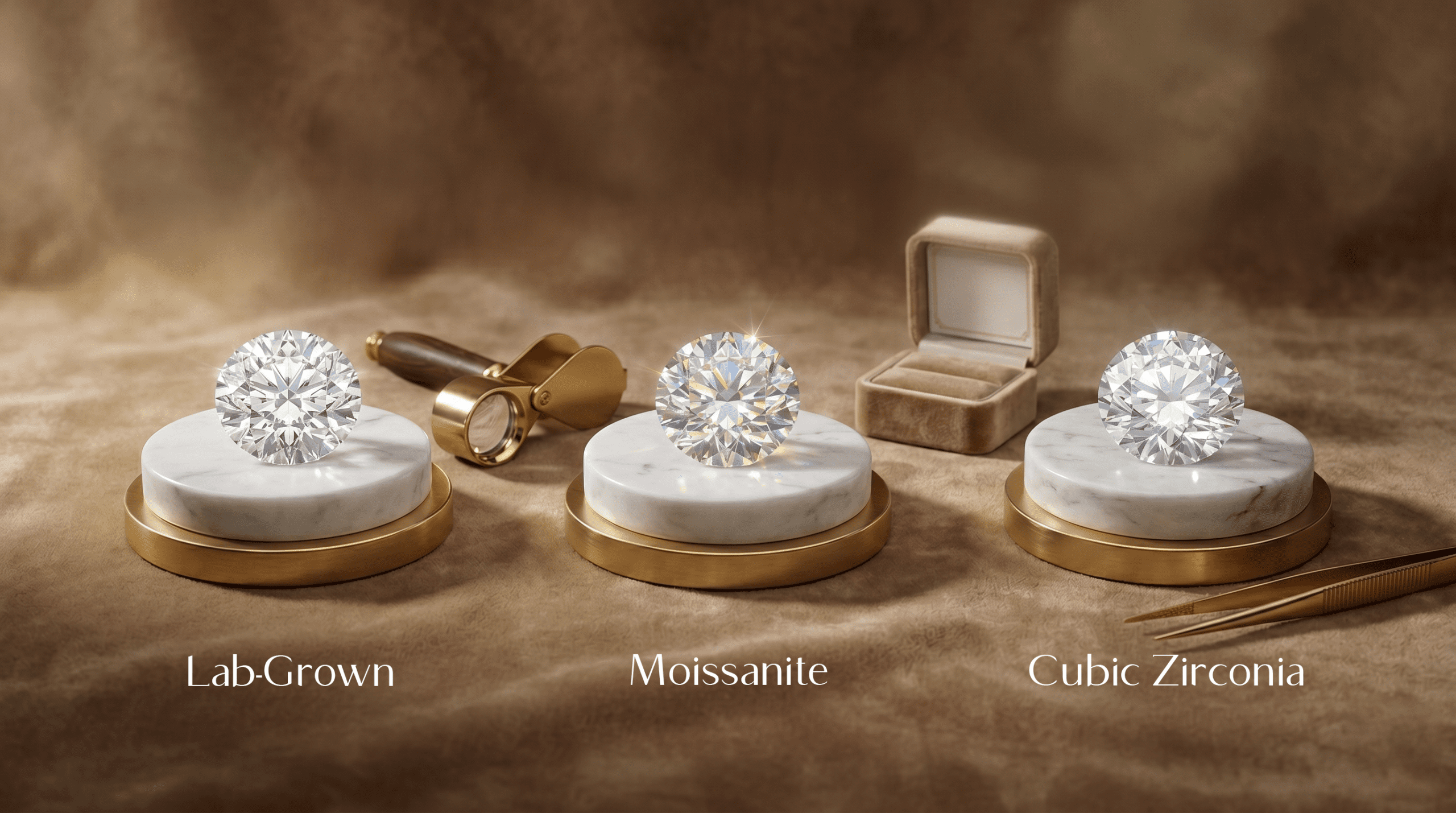
To the naked eye, these three gemstones might offer a similar dazzling brilliance, but their molecular structures are entirely different. A Lab-Grown diamond is composed of 100% pure carbon, identical to a natural diamond. In contrast, Moissanite and CZ are merely diamond simulants. Understanding their chemical properties, light refraction, and diamond hardness will empower you to make the best, most valuable decision for long-term wear.
When discussing highly brilliant jewelry, people often get confused by the alternatives available in today’s market. This is especially true when comparing Lab Grown vs Moissanite and Cubic Zirconia (widely known as CZ). While expert gem cutters can shape their exteriors to look incredibly similar, the science hidden beneath their beauty differs completely. This underlying science directly affects the durability and fire that will stay with you forever.
Distinct Origins and Chemical Structures
The base material is the very first factor that determines a gemstone’s true value. If we use scientific instruments to inspect them, we find that a Lab-Grown diamond is formed from the crystallization of pure carbon, exactly like a diamond mined from nature. Therefore, it possesses 100% of the identical physical and chemical properties of a real diamond.
Conversely, Moissanite is synthesized from silicon carbide, which is a completely different mineral. CZ is made from zirconium dioxide, a significantly heavier synthetic material that actually degrades over time. Understanding these structural facts is the crucial foundation of how to tell a real diamond accurately, rather than just trusting the naked eye.
Timeless Durability: The Diamond Hardness Scale
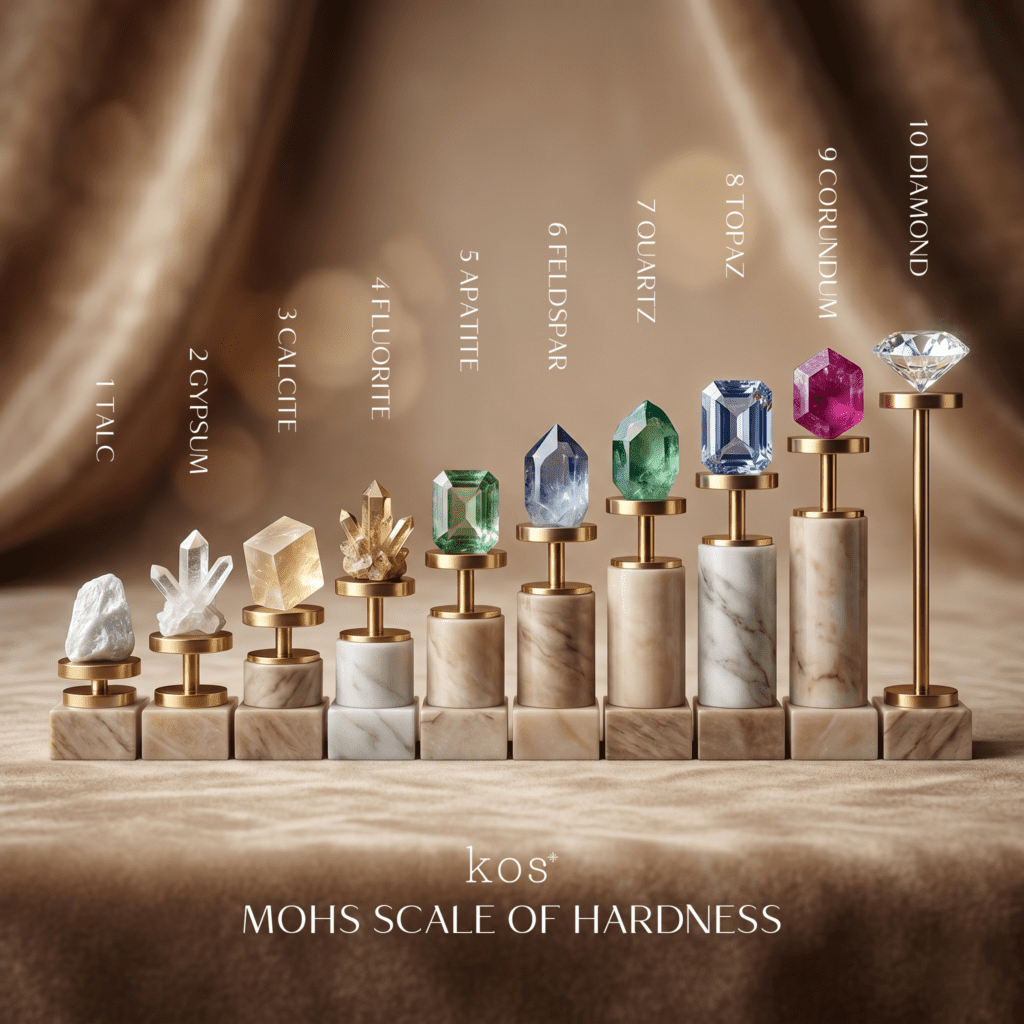
For “Quiet Luxury” pieces designed to be worn every single day, scratch resistance is the absolute heart of the matter. If a gem becomes cloudy from daily use, its luxurious appeal drops instantly. In gemology, we measure this durability using the Mohs Scale of Hardness.
Lab-Grown diamonds stand proudly at the very top with a diamond hardness rating of 10. This means absolutely no material on Earth can scratch its surface except another diamond. Moissanite follows at an impressive 9.25; while durable, it is still secondary. CZ, however, has a hardness of 8 to 8.5, putting it at a high risk of getting scratched, becoming cloudy, or even chipping after just a few years of wear.
Decoding the Sparkle: The Science of Refraction
Beyond physical toughness, what makes people fall in love with a gem is how it dances with light. We compare this specific trait using the Refractive Index.
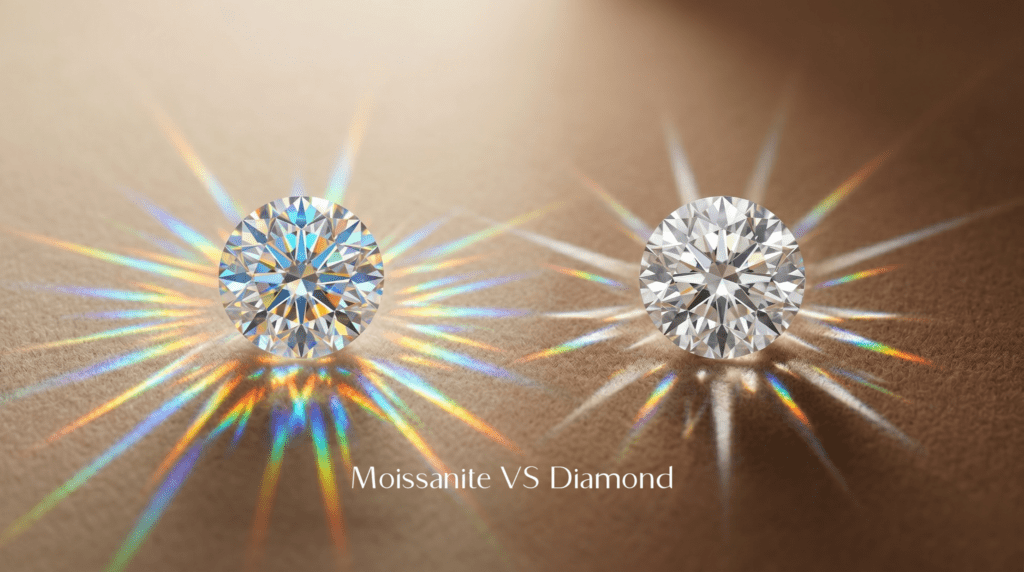
Moissanite features Double Refraction, which creates highly intense, rainbow-colored flashes that many refer to as the “disco ball effect”. Sometimes, this intense dispersion can actually look somewhat artificial under direct sunlight. On the other hand, Lab-Grown diamonds feature Single Refraction. They deliver a crisp, deep, and classic white fire. This distinct light performance is a unique characteristic of genuine diamonds that simply cannot be imitated.
Scientific Comparison Summary
| Feature | Lab-Grown Diamond | Moissanite | Cubic Zirconia (CZ) |
| Composition | Pure Carbon (100% Real Diamond) | Silicon Carbide (Simulant) | Zirconium Dioxide (Simulant) |
| Hardness (Mohs Scale) | 10 (Highest scratch resistance) | 9.25 | 8 – 8.5 (Prone to scratching or clouding) |
| Refraction (Light Play) | Single Refraction (Crisp, classic white fire) | Double Refraction (Intense rainbow / disco ball effect) | Single Refraction (Degrades and loses luster over time) |